USU Mourns the Passing of Space Physics Visionary, Revered Professor Mike Taylor
The physics professor, who joined USU's faculty in 2001 and was a celebrated teacher, pioneered camera technologies aimed at capturing atmospheric dynamics. Taylor envisioned and led the successful, NASA-funded Atmospheric Waves Experiment (AWE) mission, the largest joint endeavor undertaken by Space Dynamics Laboratory and Utah State University.
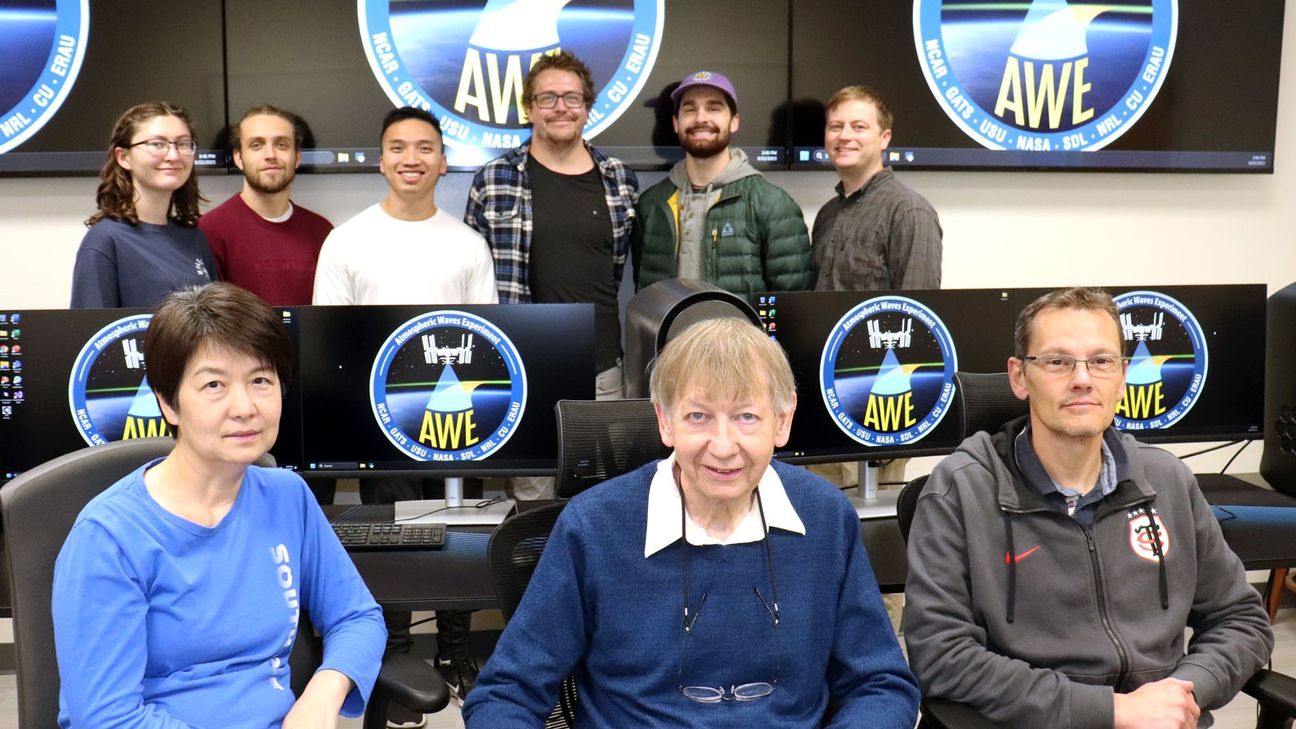
USU Physics Professor Mike Taylor, front and center, pictured in 2023 with members of USU Physics' Atmospheric Waves Experiment (AWE) Science Team. Taylor, who pioneered camera technologies aimed at capturing atmospheric dynamics and led the successful, NASA-funded AWE mission, died July 24, 2025, following an extended illness. He was 72. (Photo Credit: USU/M. Muffoletto)
Utah State University physics professor Michael John “Mike” Taylor, a pioneer in the study of atmospheric physics, died July 24, 2025, in Logan, Utah, following an extended illness. He was 72.
Taylor served as the principal investigator for the groundbreaking, NASA-funded Atmospheric Waves Experiment (AWE) Mission — the largest joint endeavor undertaken by Space Dynamics Laboratory and Utah State University — that successfully deployed an instrument to the International Space Station in 2023. The mission continues to capture never-before-seen images of Earth’s atmospheric wave activity from space.
“For decades, Mike was at the cutting-edge of developing camera technology for capture and study of upper atmospheric dynamics,” said Jan Sojka, head of USU’s Department of Physics and a longtime friend and colleague. “The AWE Mission, which is currently transmitting data to Earth, was the pinnacle of his research efforts. Mike was also a dedicated teacher and mentor to hundreds of students during his decades-long academic career.”
USU physics professor Ludger Scherliess, who succeeded Taylor as principal investigator for the AWE mission in 2023, said Taylor’s hard work, dedication and vision “made AWE a reality.”
“I remember the sparkle in Mike’s eye when he saw the first images transmitted from space by the AWE instrument. Incidentally, it was when the International Space Station was flying over his former home of Southampton, England,” says Scherliess, professor in USU’s Department of Physics. “Mike was not only a great colleague to us, but a wonderful friend. He was one of the kindest people I’ve ever known and always helped and supported everyone. His kindness, humor, smile and outgoing personality will be greatly missed.”
Russ Kirkham, SDL program manager and AWE project manager, said Taylor’s passing is “a great loss to me personally, to the AWE mission, to USU and to the atmospheric scientific community.”
“Mike’s great intellect was matched by his cheerfulness and ability to buoy up those around him,” Kirkham said.
A native of England, Taylor, who completed undergraduate, master’s and doctoral studies at the University of Southampton, met the late Doran Baker, a founding SDL engineer, when Taylor was a graduate student attending a conference in Ireland. The pair became research collaborators. Taylor joined SDL in 1991 and was subsequently offered a faculty position at Utah State in 2001.
Among Taylor’s research adventures was filming the 2006 re-entry of NASA’s Stardust capsule from a NASA-flown DC-8 aircraft.
“It was a very exciting, if short-lived, experience,” said Taylor, whom NASA tapped for the assignment due to his expertise in photographing meteors.
Taylor devoted much of his academic career to the study of atmospheric waves, which are formed by Earth’s weather and topography, occur naturally in Earth’s atmosphere and contribute to space weather. During his USU years, Taylor and his students traveled throughout the globe, capturing images of atmospheric waves from remote sites on every continent, including locations in Alaska, Canada, Chile, Brazil, Norway and Japan, along with the South Pole.
After years of observing the waves from the ground, Taylor looked forward to viewing images captured from space.
“Having the AWE instrument collecting data about the waves from the International Space Station affords us the opportunity to make measurements of the waves on a near-global scale,” he said. “This is the culmination of many years of work and determination, but the excitement is just beginning.”
Taylor is survived by his wife, Višnja Jereb Taylor, and son, Alexander Taylor, both of Logan. His obituary appears online. A visitation will be from 3-5 p.m. Thursday, Aug. 14, at Allen-Hall Mortuary, 34 E. Center St. in Logan.